
What You Need to Know
Côte d’Ivoire—also known as Ivory Coast—is one of West Africa’s most dynamic economies and a key political and commercial hub in the region. With a strong private sector, expanding infrastructure, and deep cultural influence, Côte d’Ivoire plays an outsized role in regional trade and finance. Long shaped by agriculture and migration, the country is focused today on sustained growth, industrialization, and regional leadership.
Côte d’Ivoire at a Glance
Capital: Yamoussoukro
Political & Economic Center: Abidjan
Population: ~30–31 million
Official Language: French
Government: Presidential republic
Economy: Agriculture-led with strong services and industrial growth
Key Strengths: Cocoa production, diversified economy, regional hub status
Regional Role: Economic and financial engine of Francophone West Africa
Why Côte d’Ivoire Matters
Côte d’Ivoire is the economic heartbeat of Francophone West Africa. As the world’s largest producer of cocoa and a major exporter of cashews, coffee, and palm oil, the country plays a central role in global agricultural supply chains. Its stability and growth are critical to regional economic performance, investment flows, and integration across West Africa.
Geography and Location
Côte d’Ivoire is located in West Africa, bordered by Ghana to the east, Liberia and Guinea to the west, Mali and Burkina Faso to the north, and the Atlantic Ocean to the south.
The country’s southern coastal zone supports major cities and ports, while fertile central and western regions underpin agricultural production. Northern savannah areas are more arid and closely linked to Sahelian trade and migration patterns.
People and Society
Côte d’Ivoire has a population of approximately 30–31 million people and is one of the most diverse countries in West Africa. Dozens of ethnic groups contribute to its social fabric, reflecting long-standing migration and trade links across the region.
French is the official language, while many local languages are widely spoken. Islam and Christianity are the dominant religions, often practiced alongside traditional beliefs.
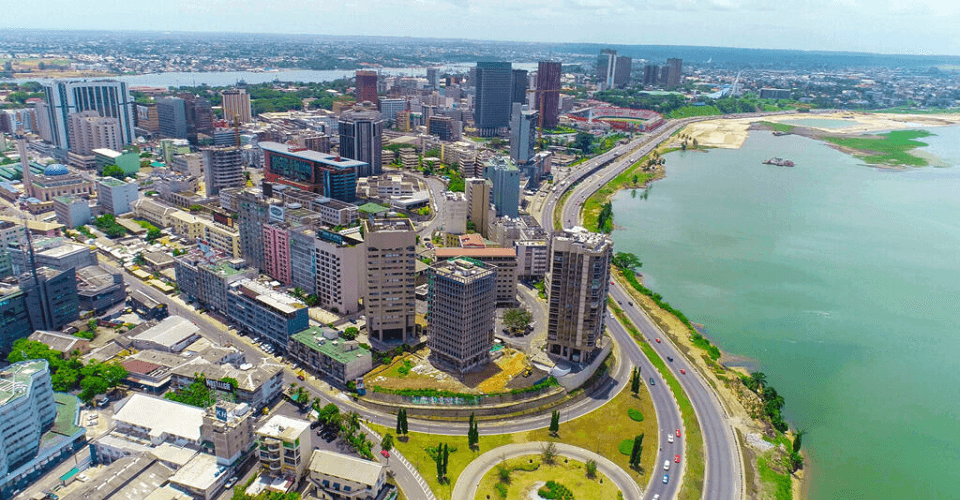
Urbanization is high, with Abidjan serving as a magnet for migrants, entrepreneurs, and regional commerce.
A Brief Historical Context
Before colonial rule, the territory was home to several powerful kingdoms and trade networks. France established control in the late 19th century, integrating Côte d’Ivoire into French West Africa.
The country gained independence in 1960 and quickly emerged as a regional economic success story, driven by agricultural exports and relative political stability. From the late 1990s through the early 2010s, Côte d’Ivoire experienced political crisis and conflict that disrupted growth.
Since then, the country has undergone a period of recovery and rapid economic expansion, rebuilding institutions, infrastructure, and investor confidence.
Government and Politics
Côte d’Ivoire is a presidential republic with a strong executive branch. Political life has stabilized following earlier periods of unrest, though debates around governance, elections, and inclusion remain part of the national conversation.
The government has prioritized economic growth, infrastructure development, and regional leadership as core policy objectives.
Economy: Agriculture, Industry, and Services
Côte d’Ivoire has one of the most diversified economies in West Africa. Agriculture remains central, with cocoa as the flagship export, alongside cashews, rubber, coffee, and palm oil.
Beyond agriculture, growth has been driven by:
Manufacturing and agro-processing
Banking and financial services
Construction and infrastructure
Telecommunications and logistics
Abidjan serves as a regional financial and commercial hub, hosting multinational firms and institutions.
Trade, Diplomacy, and Regional Influence
Côte d’Ivoire is a leading member of the Economic Community of West African States (ECOWAS) and the West African Economic and Monetary Union (UEMOA). Its ports, road networks, and financial institutions support trade across Francophone West Africa and beyond.
The country plays an active diplomatic role in regional economic integration and political dialogue.
Tourism and Cultural Heritage
Tourism in Côte d’Ivoire is growing, supported by beaches, cultural festivals, and historic sites. Grand-Bassam, a UNESCO World Heritage Site, reflects the country’s colonial-era architecture and cultural heritage.
Urban culture in Abidjan—known for music, fashion, and cuisine—adds to the country’s appeal as a cultural destination.
Safety and Travel Considerations
Côte d’Ivoire is generally considered stable, particularly in major cities and commercial centers. Travelers are advised to exercise normal caution, monitor local conditions, and follow official guidance when traveling outside urban areas.
Culture and Daily Life
Ivorian culture is vibrant and influential across West Africa. Music genres such as coupé-décalé have gained international popularity, while food, markets, and social gatherings play a central role in daily life.
Family networks, entrepreneurship, and community ties are key features of Ivorian society.
Sports and National Identity
Football is the most popular sport in Côte d’Ivoire and a powerful source of national pride. The national team’s success on the continental stage has reinforced a strong sense of unity and global recognition.